
Note: This is the third in a series on the “When Miners March Traveling Museum/Our Story Exhibit” by Wess Harris. Read the first article here.
GAY, W.Va. – Twenty years ago, in what Wess Harris characterizes as “a complete accident,” he met William C. Blizzard, whose accounts of the West Virginia Mine Wars had been lost to time.
The unlikely story began when Harris, a sociologist, educator, farmer, former miner, author and editor was following his passion – labor history, in particular of the West Virginia Mine Wars. Harris is the founder and curator of the “When Miners March Traveling Museum.” Without that chance meeting between Harris and Blizzard, there would be no traveling museum, for it is based on the book, “When Miners March: The Story of Coal Miners in West Virginia,” written by Blizzard decades ago. Harris published the first edition along with Blizzard in 2004. A second edition was printed by PM Press in 2010. Blizzard passed away in 2008 at 92-years-old.

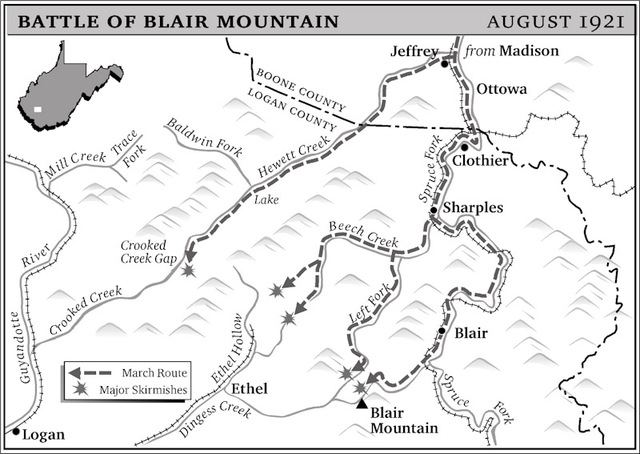
William C. Blizzard was the son of Bill Blizzard. As Harris notes in the Foreword, “Bill Blizzard was the chief protagonist in the drama played out around Blair Mountain. He led the miners’ Red Neck Army as they marched toward Logan County in 1921, hoping to bring the United Mine Workers to the scab mines of Logan and Mingo Counties.” As Harris explains, “The 1921 Battle of Blair Mountain in which thousands of miners formed an army to unionize the southern West Virginia coal fields is a story oft told.”
The younger Blizzard wrote numerous articles in the 1940s and early 1950s about the West Virginia Coal Wars. Harris explains in the Foreword, “This work was originally offered in serial form, titled, ‘Struggle and Lose…Struggle and Win!’ in the newspaper, ‘Labor’s Daily,’ of late ‘52 and early ‘53.’”
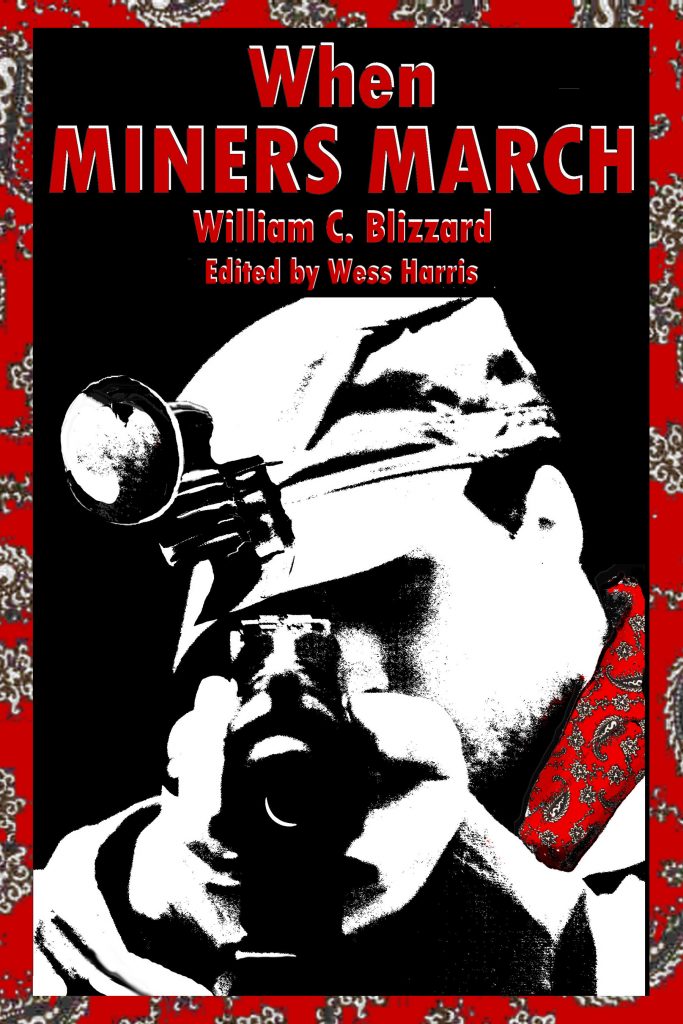
The articles were published without bylines. So, the younger Blizzard’s work contained thorough but largely ignored history until Harris met him. That history, as it turned out, is but the tip of the iceberg, as even more stories of industry abuse of miners and their families has been told in a second book edited by Harris and published by PM Press, “Written in Blood: Courage and Corruption in the Appalachian War of Extraction.”
Harris has traveled West Virginia and beyond, teaching labor history, with a focus on the United Mine Workers (UMW). While doing so, he has sold thousands of copies of “When Miners March.”
Indeed, if not for a question he asked Blizzard as an afterthought as he was leaving, Harris would have missed out on what has become his life’s work since he asked that question. Harris was on one of his explorations looking for people and places that could add to his knowledge of labor organizing, unions and their history, in particular the work of Connie West, a groundbreaking educator along with her husband Don, as well as a portrait painter of people essential to West Virginia’s coal history. Somebody told Harris about a fellow that might be able to help him.

It was William C. Blizzard.
Harris recalls, “Basically, back in 2004 as a complete accident, I met William C. Blizzard. He was living in Winfield right along the Kanawha River in an old single wide. There were wires, computers and printers everywhere. I didn’t know who he was. People said he knew Connie West.”
They met and talked for a while, then as Harris prepared to leave, he offhandedly asked him, “Did you know that Blizzard in the Mine Wars? He looked at me, hand on his chin and said, ‘Well, that was my daddy.’”
Harris continues, “I found out he had this manuscript. Nobody knew it existed. William C. had published it in the Huntington Labor Daily. I learned he had all of these artifacts from his dad. I immediately knew, ‘There goes the rest of my life.’ I immediately began trying to get him to print the thing. I knew it was an incredible history that hadn’t been told.”
As it turned out, Harris was familiar with some of the manuscript. He explains, “In the 1970s, I was teaching at the West Virginia Career College at Morgantown. All of the students were veterans from the Vietnam era. At some point, a student came up and handed me a copy of papers from the newspaper. I used it as the teaching base.” He adds, “I didn’t know it was William C. Blizzard’s work.”
He continues, “It was initially titled ‘Struggle and Lose…Struggle and Win.’ It’s a Mother Jones quote. I realized that what I had in my hands was an incredible treasure that nobody knew about that hadn’t been seen for 25 years, yet it is a vital history of the state.”
He recalls, “William C. and I talked about those papers. It seems like he was using the manuscript at Antioch in Beckley where he was teaching and a student copied it. From there, it somehow got passed on down until I got a copy.”
Harris was amazed. “I knew Bill was important in the Mine Wars, but I didn’t know how much. I tried to get a major publisher to take it, but they wanted to edit it. I said no way. It’s a primary source.” So, he published it as originally written. “We sold 5,000 copies.” He adds, “I was teaching at a book festival in Charleston and some guy from PM press saw me.” They reached an agreement to continue publishing the book. “After that, the book legacy kept rolling,” shares Harris. “As people found out about it, they started giving me artifacts. Knowing I was serious, I’ve had many rare and top quality artifacts given or loaned to me. People have been incredibly supportive. They know the history has not been told.”
He says that because his objective is to teach, he generally allows people to handle or at least touch artifacts, which is the opposite of what most museums would allow. “I always say yes,” offers Harris.
That’s true about artifacts, but also his overall commitment to ensuring William C. Blizzard’s accounts of the West Virginia Mine Wars are told. “It’s just incredible. It is the history that hasn’t been told.”
Heidi Perov courtesy of WV Humanities Council
Indeed, insists Harris, “I didn’t have a choice. It just had to be done. I could give you a book on what I have learned. I was a board member of the West Virginia Labor History Association. As time went on, they threw me off the board. What I learned is that nobody is really doing this work. To go out and look for it and teach it. Nobody does the work. So I decided to just get out there and do it.”
Yet, he is concerned. “We’re losing this history. Some of it, like Esau scrip, is just not being told, and in fact is being actively censored. Everyone is dead. Research methodology is just horrible. You’ve got to do your own homework. I tell people don’t believe a word I say. Don’t believe anybody else either.”
The decades of study, research and chatting it up with those who share first-hand accounts has taught Harris much. “There’s a whole history about the labor movement in coal mining. What I’ve learned about coal is that it’s all about the money.” Yet, he argues, the UMW is not currently positioned to effectively champion worker rights. “A lot of my education and previous study of formal organizations teaches me that the UMW has matured and done what all organizations have done – gotten outflanked.”
He adds, “I don’t mean just our Union, I mean me. The miners and the mining communities. We had best look at new solutions. The old solutions don’t work. As the rules get tighter by the people who own the companies and politicians, we just can’t be stuck in a rut. We can learn from the past but create the new future. You have to understand the history to understand where we are so we don’t repeat that. We’re trying to use old tactics in a new situation.”
Harris explains, “Capitalists have become globalized. We need to find new ways to fight. That doesn’t mean with a rife. I don’t know what it means, but we’ll need to figure it out.” He notes, “The big difficulty is that in West Virginia, our history is absolutely tied to the mines and jobs and money. I get that. What gets me is the roadblock that keeps us from reaching for our future is the experience of coal mining. It reminds me of folks in the military. It impacts the rest of their lives. Once you dig coal – I don’t back off a bit from being a coal miner (he was decades ago) – that’s the thing. The experience. If we don’t find a way to replicate that cultural bonding, we’re not going anywhere.”
Harris says having a traveling museum has afforded him hundreds of opportunities and personal encounters to share William C. Blizzard’s book and the artifacts – and stories he’s collected along the way. “The fact that I don’t have a fixed sight museum is a good thing. I teach whenever I’m out selling books. I use the artifacts to teach. People think I’m selling books. I’m not. I’m peddling history.”
“It’s just incredible. It is the history that hasn’t been told.”
Wess Harris
He continues, “I’ve had thousands go by. People ask me where I teach. I say, ‘Right here.’ My classroom is right here.” And his students are interested and engaged. “They walk up on purpose. Not for a grade or other purpose.”
Still, Harris has hopes to eventually convert the traveling museum into a permanent exhibit – in the right home, which he has not found yet. “A major university asked us to have an exhibit, but couldn’t handle the truth of it and threw us out. They just don’t know the history, the material, the period.” He hasn’t given up on the idea, though. “I must stick to the truth. I know it’s less than ideal.”
There is no disputing what he is teaching is controversial. It is more than history, though, insists Harris. “When Miners March” is instructive for our time he insists. “I’m talking about labor history, the conflict between labor and capital. What is capitalism? It’s a zero-sum game. I go at the meat of the situation. Who owns the tools? Multinational corporations own the coal. The bottom line is why aren’t we owing our own coal? What does it mean that we don’t? What does in mean to us? To some dude in New York?”
He points out that his teaching isn’t about names, dates or battles. “We start talking about the war of extraction. I ask, ‘What can we learn?’ It’s praxis – theory and practice. When I’m farming, I integrate theory and practice, when I’m teaching it’s all the same.”
Related Articles
The Rest of the Story: The ‘When Miners March Traveling Museum’ by Sociologist Wess Harris (01/23/24)
The First Coal Wars and the Convict Lease System – Preserving the Teaching of ‘Boomer’ Winfrey (11/3/23)
Fractured Sanctuary
Learn more about my book here: Fractured Sanctuary: A Chronicle of Grassroots Activists Fighting Pipelines of Destruction in Appalachia and here.
© Michael M. Barrick, 2024.
 Appalachian Chronicle
Maria,
I would surmise that Michael Barrick who wrote this article on Wess Harris would let us put it up on the Mother Jones Community Foundation website. Your thoughts?
We have at least 2 of his books!
“May Light always surround you; Hope kindle and rebound you. May your Hurts turn to Healing; Your Heart embrace Feeling. May Wounds become Wisdom; Every Kindness a Prism. May Laughter infect you; Your Passion resurrect you. May Goodness inspire your Deepest Desires. Through all that you Reach For, May your arms Never Tire.” ? D. Simone ________________________________
[…] Wess Harris Reveals His Unlikely Path as Curator of ‘An Incredible History that Hasn’t Been Told…(02/27/24) […]
[…] Wess Harris Reveals His Unlikely Path as Curator of ‘An Incredible History that Hasn’t Been Told…(02/27/24): The story behind the chance meeting that led to a lifelong turn of the work of Wess Harris. […]
[…] Wess Harris Reveals His Unlikely Path as Curator of ‘An Incredible History that Hasn’t Been Told…: The story behind the chance meeting that led to a lifelong turn of the work of Wess Harris. […]
[…] Wess Harris Reveals His Unlikely Path as Curator of ‘An Incredible History that Hasn’t Been Told… […]