

Hachette Book Group
© David Baratz, 2025
LENOIR, N.C. – Associated Press reporter Mary Clare Jalonick has written a sentinel and exceptional first draft of history about the attack on the U.S. Capitol on January 6, 2021 by supporters of Donald Trump.
Her book, Storm at the Capitol: An Oral History of January 6th, was published in January 2026, five years following that event. Based on interviews and public records, it includes the stories of those at the front line – law enforcement – who suffered and died in a nearly futile effort against overwhelming odds to protect members of Congress. Ultimately, their courage and fortitude won the day, ensuring that Vice President Mike Pence and every member of Congress escaped without physical injury.
The recollections and testimony by members of Congress from that day are chilling, as they recall how closely they came to being injured or killed, yet reveal anger at one another even as the unfolding violence was indiscriminate.
Jalonick also allows the rioters themselves to be heard; notably, most of those involved in the insurrection remain unapologetic. Indeed, one of the thousands that stormed the Capitol, Christopher Alberts, a handyman and former National Guardsman from Maryland, offered a chilling warning: “I said, ‘Next time we come here, we’re not going to be unarmed, and I can promise you that’” (p. 233).
Of course, many did come armed that day with knives, guns, chemical weapons, a pitchfork and more. Those that did not have weapons stole police shields, ammunition, fire extinguishers and anything else they could get their hands on to engage in hand-to-hand combat against the vastly outnumbered police. The rioters were ruthless and barbaric in their attacks.
Hence, most concerning about the warning by Alberts is that he is not alone in his intentions. Many of the rioters, pardoned by Donald Trump in his second term, are most likely planning a similar assault on January 6, 2029.
Therefore, Jalonick’s book is, indeed, a sentinel warning of that likelihood.
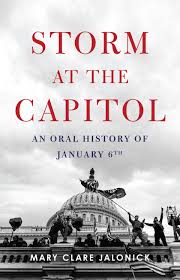
As noted following the Index, “Mary Clare Jalonick covers Congress for the Associated Press, where she has worked for two decades. She has covered politics and policy under five presidents and reported from inside the Capitol on January 6th.”
The chapters are sequential, following events by the hour from the early morning of January 6th through the early morning of January 7th.
Beginning with a Timeline of January 6th, she reports that at 8:17 a.m., “On Twitter, President Donald Trump urges Vice President Mike Pence to try to overturn his presidential defeat when he presides over the congressional session to count electoral votes later that day: ‘Do it Mike, this is a time of extreme courage!’”
Then, Jalonick reports, at 11:57 a.m., “Trump begins his speech to thousands of assembled supporters on the Eclipse in front of the White House. He encourages the crowd to walk to the Capitol and says he will go with them.” Ultimately, Trump did not follow through on that promise.
However, as she notes, at 12:53 p.m., “Protesters arrive at the Capitol and quickly breach weak police barricades at the West Front.” Five minutes later, “Capitol Police Chief Steven Sund requests assistance from the Metropolitan Police Department as protesters overwhelm Capitol Police and quickly advance toward the building.” At 2:13 p.m., “The Capitol Building is breached when rioters break in on the first floor of the Senate.”
For the next four hours, rioters trash the Capitol and come within moments and just a few feet from kidnapping or killing members of Congress, their staffs and reporters. Exhausted and injured police from the Metropolitan Police Department and Capitol Police perform multiple acts of heroism, managing to gain the upper hand.
It isn’t until 5:20 p.m. that “The National Guard arrives to assist with clearing the Capitol complex,” reveals Jalonick. This despite pleas from police, Pence, Speaker Nancy Pelosi, and numerous other lawmakers asking the Pentagon for reinforcements.
In the Author’s Note, Jalonick, a graduate of Davidson College, writes, “I began reporting this oral history in the moments just after the January 6, 2021 attack on the Capitol began. I conducted my first interviews while I was evacuating from the gallery of the House after crouching on the floor for safety, with rioters just outside the doors.” She continues, “In the years since, as a congressional reporter for the Associated Press, I have collected stories from lawmakers, police, reporters, and staff.”
She notes, “Many lawmakers, especially Republicans who have backed President Donald Trump, will not go on the record, though some have. But they all have a story, and once they start talking, it is often hard for them to stop.”
Jalonick observes, “It was a traumatic event for everyone involved, whether they acknowledge it publicly or not.”
Additionally, she writes, “I have collected the stories of some of the rioters as well, from court transcripts, FBI interviews that have been made public, official testimony, and personal interviews.” Those rioters, she notes, injured at least 140 officers, “… but as one officer noted in an interview, the real number of injured was likely much higher than that, and many of them simply returned to work without complaint. Others were so seriously injured that they never returned to work at all.”
Indeed, Capitol Police Officer Brian Sicknick died on January 7 of two strokes after being assaulted by rioters the day before. Others committed suicide in the days and weeks afterward.
“Next time we come here, we’re not going to be unarmed, and I can promise you that.” – Rioter Christopher Alberts of Maryland
The book, just over 300 pages long, includes maps and startling photographs of that day, including a protester holding the Confederate flag in the Capitol, something the Confederate Army was never able to achieve during the Civil War.
The book is a quick read and certainly the most comprehensive first-hand account of the day that our Republic almost died. For those that did die, and for those that value the Rule of Law and the ideals articulated in the Declaration of Independence and the Unites States Constitution, Jalonick’s account is an essential read.
© Michael M. Barrick, 2026. Storm at the Capitol was published by Hachette Book Group with Mary Clare Jalonick owning the Copyright; this review is permitted under the Fair Use Doctrine (Section 107 of the Copyright Act).
 Appalachian Chronicle
[…] This war poses the greatest threat generated to our nation by Donald Trump during his time as president, which is saying a lot considering the January 6, 2021 Storm on the Capitol. […]
[…] Book Review: ‘Storm at the Capitol: An Oral History of January 6th’ is a Sentinel First Draft of… […]