
Note: This is the second in a series on the “When Miners March Traveling Museum” by Wess Harris.

CHARLESTON, W.Va. – Today marks the 134th anniversary of the meeting that led to the formation of the United Mine Workers of America (UMWA). According to e-WV: The West Virginia Encyclopedia, “On January 23, 1890, rival miners’ organizations met in Columbus, Ohio, to organize the United Mine Workers of America. Founded two days later, John B. Rae, a Scottish immigrant, became the first president. Just three months later, in Wheeling, UMWA District 17, encompassing most of West Virginia, held its first meeting, elected M. F. Moran as district president and immediately launched what became an extraordinary struggle of more than 40 years to unionize the state’s coal mines.”1
The Rest of the Story

Wess Harris, a sociologist, educator, author and editor, agrees that the effort to unionize West Virginia’s coalfields was “an extraordinary struggle.” However, he argues that the official accounts of the treatment of union leaders, members, and their families is sanitized by the state of West Virginia and Appalachian regional historians, sociologists, universities and museums.
He has the evidence to support his contention. In fact, as the founder and curator of the “When Miners March Traveling Museum,” he has led more than a thousand people – many college students – on what he calls “Truth Tours” to the West Virginia State Museum in Charleston. Those tours have not been received well by the powers-that-be.
“‘Written in Blood’ shines a critical light on the untold true history of the West Virginia Mine Wars.”
Mari-Lynn Evans, director and producer of “Blood on the Mountain.”
While his work has agitated those seeking to sanitize the truth, his tours are based on his decades-long collection of hundreds of coal mining artifacts, many of them one of a kind, and is reflected in two books Harris has edited. “When Miners March” and “Written in Blood: Courage and Corruption in the Appalachian War of Extraction,” have caused a stir among the gatekeepers of Appalachia’s Coal Mining history.
Indeed, Harris has converted the “When Miners March Traveling Museum” into a permanent exhibit entitled, “Our Story.” The work of Harris and several others, it has become a living metaphor of telling the whole truth about the tactics of coal operators. Initially scheduled for exhibit at a major university in Southern Appalachia (more on that in a future story), the truth that rape was institutionalized in parts of the coal industry simply proves too much to reveal. The traveling museum and books convey not only the long history of the UMWA’s effort to secure the livelihoods and lives of their members, but shares a startling truth that others tend to disregard, or worse, deny.

The back cover of “When Miners March,” which is about the Battle of Blair Mountain, teaches, “Over half a century ago, William C. Blizzard wrote the definitive insider’s history of the Mine War the resulting trial for treason of his father, the fearless leader of the Red Neck Army” in the Battle of Blair Mountain. Indeed, Howard Zinn, author of “A People’s History of the United States” said, “‘When Miners March’ is an extraordinary account of a largely ignored but important event in the history of our nation.”
Bill Blizzard, a man of courage and tenacity born in 1892, led thousands of miners in 1921 on a 50-mile march across the rugged mountains of southwestern West Virginia, culminating in the Battle of Blair Mountain. His son, William C. Blizzard, wrote “When Miners March” in the early 1950s. Harris notes, “It is the definitive account of the West Virginia Mine Wars of the early 20th century – who shot whom, when, where and why. Too controversial to publish in the 50s, his book finally saw the light of day in 2004.”
Esau Scrip: Big Coal’s Sordid Secret
Indeed, truth is often delayed, but eventually often comes to light.
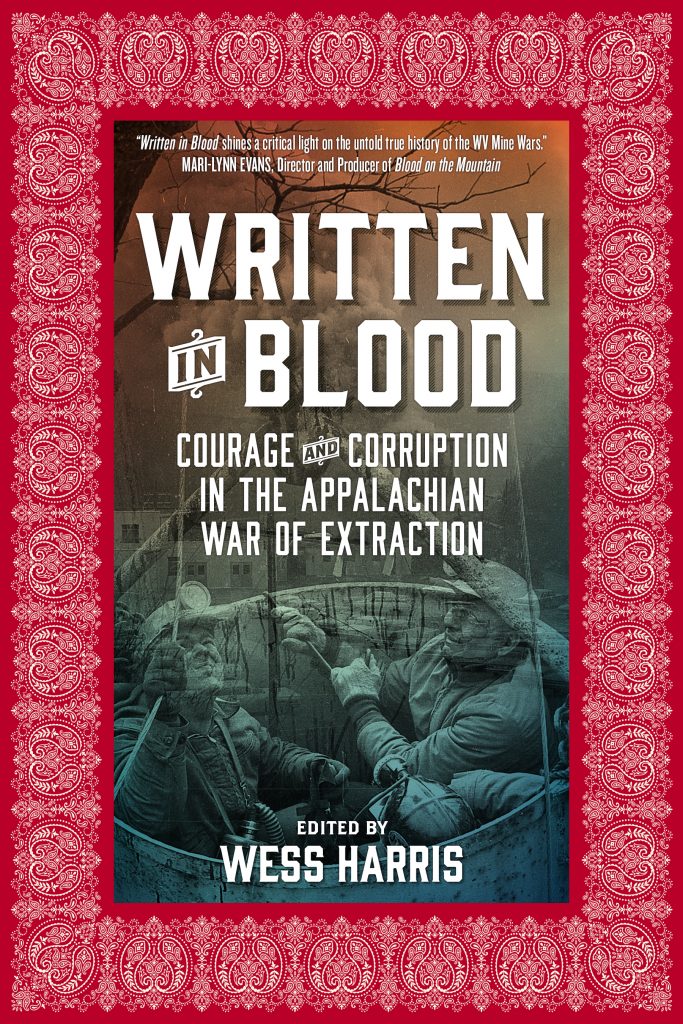
That is why “Written in Blood: Courage and Corruption in the Appalachian War of Extraction,” published in 2017 by Appalachian Community Services and PM Press is, at best, an uncomfortable read. It tells of the Esau scrip system for women, essentially an institutionalized practice of forced sexual servitude that was part of coal company policy, at the Whipple Company Store in Oak Hill and in mines throughout the area in a radius of about 50 miles, says Harris, who says there are others across the state as well. Notably, the West Virginia online encyclopedia makes no mention of this practice.
Mari-Lynn Evans, director and producer of “Blood on the Mountain” says, “Written in Blood” shines a critical light on the untold true history of the West Virginia Mine Wars.”
Maria Gunnoe, Goldman Environmental Prize winner and recipient of the University of Michigan Raoul Wallenberg Medal, adds, “For two hundred years, the coal industry has promised us prosperity. ‘Written in Blood’ leaves little doubt that the prosperity never arrives. The promise itself is contingent on us agreeing to our own destruction. We must agree to stand idly by as they destroy our communities, water, air, health, and lives. We owe them nothing. They owe us everything.”
© Michael M. Barrick, 2024.
1Thomas, Jerry Bruce “United Mine Workers of America.” e-WV: The West Virginia Encyclopedia. 01 March 2023. Web. 23 January 2024.
 Appalachian Chronicle
Please see Blood on the Mountain at https://motherjoneswv.org/films/
Excellent writing!
“May Light always surround you; Hope kindle and rebound you. May your Hurts turn to Healing; Your Heart embrace Feeling. May Wounds become Wisdom; Every Kindness a Prism. May Laughter infect you; Your Passion resurrect you. May Goodness inspire your Deepest Desires. Through all that you Reach For, May your arms Never Tire.” – D. Simone
[…] Note: This is the second in a series on the “When Miners March Traveling Museum/Our Story Exhibit” by Wess Harris. Read the first article here. […]
[…] The Rest of the Story: The ‘When Miners March Traveling Museum’ by Sociologist Wess Harris (01/23/24) […]
[…] The Rest of the Story: The ‘When Miners March Traveling Museum’ by Sociologist Wess Harris (01/23/24): Includes references to two books edited by Wess Harris: “When Miners March” and “Written in Blood: Courage and Corruption in the Appalachian War of Extraction.” Both are must reading for any person wishing to understand the whole, sordid story of the tactics of coal operators. […]
[…] The Rest of the Story: The ‘When Miners March Traveling Museum’ by Sociologist Wess Harris: Includes references to two books edited by Wess Harris: “When Miners March” and “Written in Blood: Courage and Corruption in the Appalachian War of Extraction.” Both are must reading for any person wishing to understand the whole, sordid story of the tactics of coal operators. […]
[…] The Rest of the Story: The ‘When Miners March Traveling Museum’ by Sociologist Wess Harris […]