By Ron Sinclair
“When I was young, I admired clever people. Now that I am old, I admire kind people.”
― Abraham Joshua Heschel
Until the early part of this century, I knew little about Rabbi Abraham Joshua Heschel. As a teenager, I knew that he was against the war in Vietnam and was a strong advocate for racial equality. He and Rev. Dr. Martin Luther King Jr were contemporaries, and would sometimes appear together in support of racial equality and against the war. But I did not know much about the man, nor about what drove his beliefs and his work. And I confess to knowing little about the Jewish faith.
In my lifetime, I have found that God has a way of sending us what we need, when we most need it. On a youth choir tour to Canada, we stayed at an ecclesiastical retreat center in Toronto. In their bookstore, I picked up a small paperback book of the Essential Writings of Abraham Joshua Heschel. Both during that tour and afterwards, I spent a great deal of time with my head and my heart buried in that book. And I felt as though I was sharing time with a true wisdom teacher.
Life is all about relationships. It is about you, and me, and our neighbor down the street, and the unhoused folks wandering our streets. Every major religion teaches this as a core principle. We are all tied together in this world, and are supposed to care for one another with a kindness that can only come from seeing “the other” as another child of the Great Creator. We’re all just pilgrims making our way through this life. We all have fears. We all have faults. We all hurt and love and cry and laugh and dance and sing. We all live. We are meant to share our stories, and anything less is hardly life at all. Living in isolation breeds distrust which creates fear, and in turn leads to violence against those who are in some way different from us.
Being on a bus with 50 other people for 14 days is an experience I wish everyone could have. It’s an experience that brought much of Heschel’s writings to life. We made music together, and in making that music we shared our program’s thematic message with all we met on our travels, including one another. We worked in homeless shelters, making music for and with folks coming to eat or to find shelter for the night. We talked with them. We listened to their stories, and told them ours. Those were profound experiences that made us grow as human beings. Some of the stories we heard would make us weep, individually and sometimes collectively.
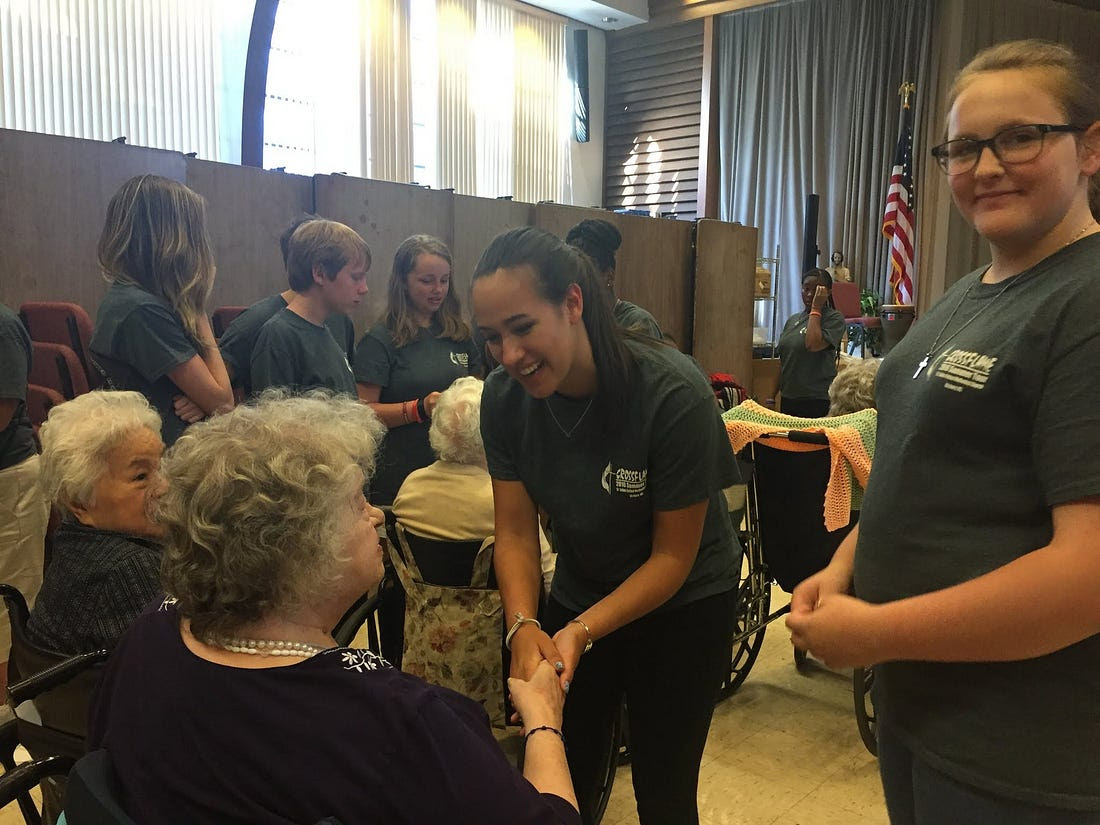
We held music and drama and arts camps for children in underserved communities. We sang in nursing homes and VA hospitals. And in one of those visits, a resident with dementia thought that one of our singers was his daughter who had died a few years earlier. His wife told our singer that he could not remember that their daughter had died, and he cried every day because she had not come to see him. Our 15 year old singer, with a huge heart and a bit of wisdom beyond her years, hugged the old man tightly and apologized for not having come to see him for so long. As we left the VA nursing home that day, the old man’s wife and our young singer shared hugs and tears together. And they exchanged contact information. I like to think that they are still in touch today.
And of course, on the bus, and in the campgrounds, retreat centers and hotels where we stayed on our tours, we were forced to be with the same people for the entire 14 days. On some trips, we filled two buses, and the opportunities for conflict and for growth doubled. And while there was some conflict, we all concentrated on an understanding that we all need one another, and the conflicts were fewer than you might expect. Kindness towards strangers, kindness towards our traveling companions and kindness towards ourselves was almost always evident.
The tenor of our times is to separate into us vs them. I don’t even need to point out how deeply divided we are based upon race, religion, place of birth, sexual orientation, and where we live. Instead of celebrating our differences and seeking common ground, we distrust anyone not like us, and we make them our enemies. We retreat into silos, even on social media. As a society, we seem to have fewer and fewer in person shared experiences. I contend that we are suffering because of it.
Our choir was a ministry of our St. Luke’s United Methodist Church. A core principle was that everyone was invited to be part of our group. There was no audition, no test of faith. Our goal was to bring folks together, and let God lead us where God wanted us to go. Over time, our membership included Jews, Muslims, Hindus, and agnostics and atheists. Our choir was white, black, Latino, Asian, American Indian, and mixed race. Our choir had members who were lesbian, gay, straight, bisexual and even transgender. ALL were recognized by us as God’s children. ALL were welcomed with open arms, open hearts and offered the dignity and respect each one of us deserves in this world. Over and over again on our tours, I heard people say “You look like a melting pot.”
I’ve been wrestling with comments on social media that drive a stake into the heart of much of what I believe to be true. It seems that our divisions have become so great that it is acceptable to wipe the world clean of those who do not see things our way. Instead of coming together, we look for every opportunity to condemn and divide. Clever comments and arguments are gleefully tossed out instead of honestly communicating with others as human beings in their own right. Crafting the perfect argument and perfect “put down” seem more important than anything else. The more clever the put down, the more it is celebrated. Yet, we are ALL children of God on a very fragile boat together. More and more, I admire and appreciate kindness.
“The greatest commandment is to love the Lord your God with all your heart, soul, mind and strength. And another like it, to love your neighbor as yourself.” – Matthew 22:37-39
© Ron Sinclair, August 25, 2026. Sinclair is a retired church musician and solo performer. Sinclair writes about aging, retirement, ‘the church,’ his farm, family and anything else he considers of interest.

